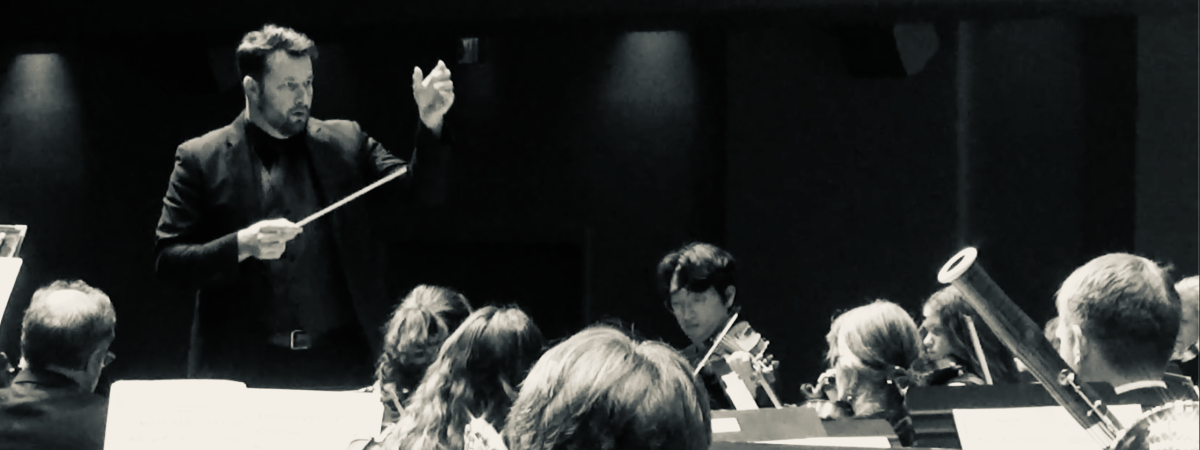
We will be peace is a program meant to explore aspects of peace and its absence. Our program opens with University Chorus’ uplifting and tranquil repertoire, meant to strengthen our hope and resolve toward peace.
Jamey Ray’s Peace sets Sara Teasdale’s poetry that speaks to the tranquility of inner peace through a series of comparisons with the reflections of light within a tidepool. Our spirit, our inner calm is that tidepool, ever still despite the sea and passage of time.
Peace flows into me
As the tide to the pool by the shore;
It is mine forevermore,
It ebbs not back like the sea.
I am the pool of blue
That worships the vivid sky;
My hopes were heaven-high,
They are all fulfilled in you.
I am the pool of gold
When sunset burns and dies, —
You are my deepening skies,
Give me your stars to hold.
Felix Mendelssohn’s Lift Thine Eyes is one of the many musical gifts in his famous oratorio Elijah. In this moment of the oratorio, a weary Elijah is comforted by a trio of angels who sing this celestial music. In our program today, it is a needed message of hope for any who are downtrodden.
Lift thine eyes to the mountains,
Whence cometh thy help.
Thy help cometh from the lord,
The maker of heaven and earth.
He hath said thy foot shall not be moved.
Thy keeper will never slumber.
Mark A. Miller’s I Believe is a flowing and beautiful setting of an anonymous Jewish text that is attributed to several situations. Regardless of the cloudiness of the text’s origin, it speaks to the inner resolve and faith that people can have in the darkest of times.
I believe in the sun even when it’s not shining.
I believe in love even when I can’t feel it.
I believe in God, even when he is silent.
Jocelyn Hagen and Dessa collaborated on Controlled Burn for a commission by the Minnesota Public Schools. Dessa is a hip-hop artist, and Hagen is a composer primarily of choral music. The music and text mix the fires of turmoil with the reassuring comfort of knowing that time can heal many wounds.
We’re born with a fuse
timed to ignite
It burns through our youth
then sets us alight
for a while
And when we’re older
we’ll laugh and say that we were only kids
but no one gets closer to the burn of love and loss than this
When the fires pass over
all you’ll recall
is the ash on your shoulders
some lines on your palm
The world’s made in motion
we’re carried along;
the current won’t hold for long
If you could stand your younger selves behind you
then turn and walk the line,
how many strangers might surprise you,
too changed by time to recognize
Memory relents
like rain melts the limestone
the years that you spent
in flame seem so strange now
Sarah Quartel’s Carry the Music serves as an anthem that champions the idea of continuing to sing our song — taking comfort in our places of peace and safety. Even after we come out of the fire, our duty is to continue to bring joy to the world and revel in the strength drawn from our enduring communities.
I see you, I hear you.
Here, I am happy.
Here, I am safe and loved.
Here, I am joyful and at peace.
Here, I am comforted, nourished, and brave.
Part of the song, part of the adventure.
And I carry the music on, my friend, carry the music on.
Join the story, join the song, carry the music on.
Here, we are united.
Here, we have a home.
Here, we are accepted and believed.
Here, we are powerful, rooted, and strong.
Part of the song, part of the adventure.
And we carry the music on, my friend, carry the music on.
Join the story, join the song, carry the music on.
I hear you when your voice is silent.
I hear you when your song is lost.
You are not alone.
Carry the music on, my friend, carry the music on.
Join the story, join the song, carry the music on.
Concert Choir
From Composer Caroline Shaw:
To the Hands begins inside the 17th century sound of Buxtehude. It expands and colors and breaks this language, as the piece’s core considerations, of the suffering of those around the world seeking refuge, and of our role and responsibility in these global and local crises, gradually come into focus.
The prelude turns the tune of Ad manus [Dietrich Buxtehude’s root work to which this piece responds] into a wordless plainchant melody, punctured later by the strings’ introduction of an unsettling pattern.
The second movement fragments Buxtehude’s choral setting of the central question, “quid sunt plagae istae in medio manuum tuarum,” or “what are these wounds in the midst of your hands.” It settles finally on an inversion of the question, so that we reflect, “What are these wounds in the midst of our hands?” We notice what may have been done to us, but we also question what we have done and what our role has been in these wounds we see before us.
The text that follows in the third movement is a riff on Emma Lazarus’ sonnet The New Colossus, famous for its engraving at the base of the Statue of Liberty. The poem’s lines “Give me your tired, your poor/Your huddled masses yearning to breathe free” and its reference to the statue’s “beacon-hand” present a very different image of a hand — one that is open, beckoning, and strong. No wounds are to be found there — only comfort for those caught in a dangerous and complex environment.
While third movement operates in broad strokes from a distance, the fourth zooms in on the map so far that we see the intimate scene of an old woman in her home, maybe setting the table for dinner alone. Who is she, where has she been, whose lives has she left? This simple image melts into a meditation on the words in caverna from the Song of Solomon, found in Buxtehude’s fourth section, Ad latus.
In the fifth movement the harmony is passed around from one string instrument to another, overlapping only briefly, while numerical figures are spoken by the choir. These are global figures of internally displaced persons, by country, sourced from the Internal Displacement Monitoring Centre (IDMC) data reported in May 2015. Sometimes data is the cruelest and most honest poetry.
The sixth and final movement unfolds the words in caverna into the tumbling and comforting promise of “ever ever” — “ever ever will I hold you, ever ever will I enfold you”. They could be the words of Christ, or of a parent or friend or lover, or even of a nation.
I. Prelude
[no text — choir on vowels only]
II. in medio / in the midst
[text from Buxtehude’s Ad manus — Zechariah 13:6 — adapted by Caroline Shaw, with
the addition of in medio manuum nostrarum (“in the midst of our hands”)]
quid sunt plagae istae
quid sunt plagae istae in medio manuum tuarum in medio
quid sunt plagae istae
quid sunt plagae istae in medio manuum nostrarum
translation:
what are those wounds
what are those wounds in the midst of your hands in the midst
what are those wounds
what are those wounds in the midst of our hands
III. Her beacon-hand beckons
[text by Caroline Shaw, responding to the 1883 sonnet “The New Colossus” by Emma Lazarus, which was mounted on the pedestal of the Statue of Liberty in 1903]
Her beacon-hand beckons: give
give to me
those yearning to breathe free tempest-tossed they cannot see what lies beyond the olive tree whose branch was lost amid the pleas for mercy, mercy
give
give to me
your tired fighters fleeing flying from the
from the
from
i will be your refuge
i will be your refuge
i will be
i will be
we will be
we will
IV. ever ever ever
[text by CS — the final line, in caverna, is from Buxtehude’s Ad latus — the line from the Song of Songs, in foraminibus petrae, in caverna maceriae, or “in the clefts of the rock, in the hollow of the cliff”]
ever ever ever
in the window sills or
the beveled edges
of the aging wooden frames that hold old photographs
hands folded
folded
gently in her lap
ever ever
in the crevices
the never-ending efforts of
the grandmother’s tendons tending to her bread and empty chairs
left for Elijahs where are they now
in caverna in caverna
V. Litany of the Displaced
The choir speaks global figures of internal displacement, sourced from the Internal Displacement Monitoring Centre. The numbers spoken are the numbers of internally displaced persons by country, in ascending order. These are people, some of whom may have legal refugee status, who have been displaced within their own country due to armed conflict, situations of generalized violence or violations of human rights.
VI. i will hold you
[text by Caroline Shaw — The final line is a reprise from the Zechariah text.]
i would hold you
i would hold you ever ever will i hold you ever ever will i enfold you
in medio
in medio manuum tuarum
Camerata
Louis Vierne’s Kyrie is the first part of his Messe Sollenelle (Solemn Mass), written for St. Sulpice in Paris. The entire Mass is antiphonal in conception, with the choir and petite organ at the front of the nave and the great organ in the gallery at the rear. Today, we present it in a chamber orchestration featuring piano and string quintet. On our program, the piece represents the harrowing cry of humanity, pleading for mercy from turmoil.
Kyrie eleison, Christe eleison, Kyrie eleison.
[Lord have mercy, Christ have mercy, Lord have mercy]
Randall Thompson’s The Paper Reeds by the Brooks is excerpted from his larger choral cycle The Peaceable Kingdom, which is based on texts related to peace from the book of Isaiah and inspired by the painting of the same name by Edward Hicks. This subdued a capella piece is connected to the following piece through the brooks of water imagery and how all whithers when the brooks run dry.
The paper reeds by the brooks,
By the mouth of the brooks,
Shall whither, be driven away,
And be no more.
Herbert Howells’ Like as the hart desireth the waterbrooks is one of the most beloved anthems in the choral world. Its lush harmony and expressive melodies convey a most authentic sense of yearning and desire for the waters of life and peace.
Like as the hart desireth the waterbrooks,
So longeth my sould after thee.
My soul is athirst for God.
Ye, even for the living God.
When shall I come to appear before the presence of God?
My tears have been my meat day and night.
While they daily say unto me: Where is now thy God?
Bound for the Promised Land is an old American tune from the shapenote tradition spread by the great revivals of the 19th century. Its words describe the aspiration for a better land, a better home for the faithful.
On Jordan’s stormy banks I stand
And cast a wishful eye
To Canaan’s fair and happy land,
Where my possessions lie.
There generous fruits that never fail
On trees immortal grow;
There rocks and hills and brooks and vales
With milk and honey flow.
I am bound for the promised land,
I am bound for the promised land
O who will come and go with me
I am bound for the promised land.
O the transporting rapt’rous scene
That rises to my sight;
Sweet fields arrayed in living green
And rivers of Delight.
Soon will the Lord my soul prepare
For joys beyond the skies,
Where never-ceasing pleasures roll,
And praises never die.
I am bound for the promised land,
I am bound for the promised land
O who will come and go with me
I am bound for the promised land.
Morten Lauridsen’s Sure on this Shining Night sets a portion of James Agee’s longer work Descriptions of Elysium, which was first set by composer Samuel Barber. The music is rich, tuneful, and comforting. It is our hope that we all find the kindness needed to bask in the glory of a shining night – when all is healed and all is health.
Sure on this shining night of star-made shadows round,
Kindness must watch for me this side the ground,
On this shining night.
The Late year lies down the north,
All is healed, all is health.
High summer holds the earth, hearts all whole.
 Howard Eckdahl