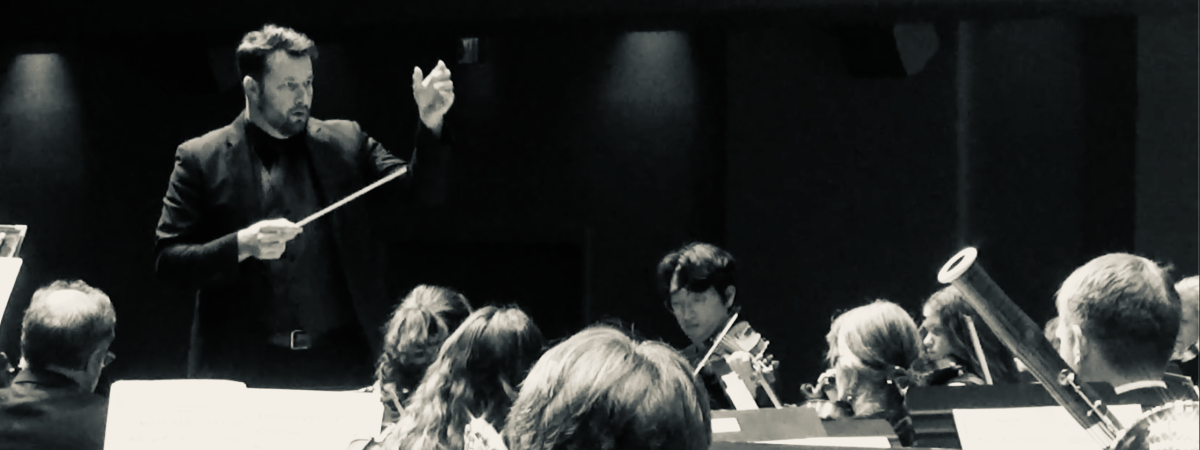
Today’s program is about love, its wonderful breadth, and how it touches us all.
Part I – Sacra/Profana
Palestrina was a Renaissance composer in Rome during the 16th century. He is known for his mastery of vocal counterpoint, displayed in polyphonic sacred works he wrote while in the employ of the Vatican. The two works we are singing today are examples from Il primo liber di madrigali (The first book of madrigals) which was published in 1555. Madrigals are typically secular works and represent a smaller portion of Palestrina’s output, which was predominantly sacred. His reputation is one of the most pristine in musical history – not only for the beauty and craft of his music and mastery of polyphony, but also the way he deployed such within the requirements of the post-Tridentine Catholic church. His madrigal style was more conservative than that of his contemporaries – indeed they sound akin to his sacred works – but we are still witness to an expressive composer who sets text vividly. Palestrina later repented for these earthly works when he wrote more devotedly for the church.
Mentre ch’al mar descenderanno
As long as the rivers fill the sea,
And the wild creatures love shady valleys,
Her eyes will yet be shrouded in a cloud,
And in my eyes such a cloud brings continuous rain,
In her breast there is hardened ice,
Which draws cold sighs from mine.
–Francesco Petrarca
Lontan dalla mia diva
Far from my lady,
to be close to you again almost destroys me
with pain and burning desire.
If I am far from you, never has there been
Such an ardent furnace blazing
So hot as in my heart with lofty desire.
If I am close to you,
I melt like a snowflake in the sun.
O, the infinite misery of lovers!
Suffering long boredom for brief joy,
Sighs, sadness, torment, worries and tears.
–Unknown
Anton Bruckner wrote Locus Iste in 1869. It is based off of the gradual Locus Iste, which is proper for the dedication of a church. Appropriately, Bruckner penned the four-part motet for the consecration of chapel in the new cathedral in Linz, Austria, where he was organist.
Locus Iste is related to Palestrina by way of the Cecilian movement, which is named after Saint Cecilia, the patron of music. It was centered in Germany and flourished during the 19th century against the influence of romanticism, industrialization, and the expansion of the Catholic church’s musical forces in the late 18th and early 19th centuries. The objective of the Cecilian movement was to return to the ideal of Palestrina, especially by focusing on unaccompanied voices.
Interestingly, the two examples we hear on today’s program (Locus Iste and Os Justi) present some juxtapositions. First, musical language of the earlier motet (1869’s Locus Iste) displays more chromaticism and less counterpoint than Os Justi from ten years later. Second, the conglomeration of text in the later motet (Os Justi) is perhaps more liberal in nature than the music thereof, which does not stray from the Lydian mode – a strict adherence to Renaissance sacred practice.
Since the Cecilian movement was in full swing during the years Bruckner composed for the church, and because he was not an ardent supporter of the movement, it follows that the composition he wrote for a church closer to him personally (1869’s Locus Iste) is much less within the confines of it. Conversely, the Motet (Os Justi) he dedicated to Ignaz Traumhiler, a strong supporter of the Cecilian movement, stays much more within the conservative Cecilian lines. It is by this observation we can see the forces at work in the later church works of Bruckner. Most interestingly, though, is how Bruckner’s craft burst forth from the strictures of the Cecilian movement, with each motet having a different manner of accomplishing this: the chromaticism through the a Capella, Latin texture of Locus Iste and the glorious-to-near-abuse of prepared dissonances in the neo-Palestrinian idiom of Os Justi.
Locus Iste
This place was made by God
A priceless Sacrament
It is irreprehensible.
–Gradual for celebrating the dedication of a church
Ola Gjeillo is a composer of sacred and concert music from Norway, currently residing in the United States. His setting of the Ubi Caritas text has held its own against the beloved setting by Maurice Duruflé [DUR-roo-flay], which is no small feat. Like the Duruflé, Gjeilo’s setting is based on a chant, but one of the composer’s own making. It also contrasts in texture: where Duruflé sets the chant more polyphonically, Gjeilo’s is purely homophonic. Ultimately, Gjeilo’s setting leaves us with beautiful music that conveys the warmth of the text through familiar sacred music textures.
Ubi Caritas
Where charity and love are, God is there.
The love of Christ has gathered us together.
Let us rejoice and be glad in it.
Let us revere and love the living God.
And from a sincere heart let us love one another.
–Paulinus of Aquileia
Eric Thiman (pronounced TEE-man) was an English composer of the 20th century who is best known for writing music in the non-conformist sacred tradition. English choral music is frequently related to the Anglican church and its liturgies, manifested as anthems and canticles amongst other forms, so Thiman is something of an outlier for writing music apart from that tradition. Waller’s poem Go, lovely rose enjoys a number of choral settings, with this one being a simple and charming interpretation of the well-loved text. Thiman’s setting avoids over-dramatizing the simple poem and conveys a sincerity and fondness that is sometimes overlooked in settings of this text.
Go, Lovely Rose
Go, lovely rose!
Tell her, that wastes her time and me,
That now she knows,
when I resemble her to thee,
How sweet and fair she seems to be.
Tell her that’s young,
and shuns to have her graces spied
That had’st thou sprung
in deserts where no men abide
Thou must have uncommended died.
Small is the worth
of beauty from the light retired:
Bid her come forth,
suffer herself to be desired,
[and not blush so to be admired.]
Then die! That she
the common fate of all things rare
May read in thee
how small a part of time they share
That are so wondrous sweet and fair.
– Edmund Waller
Part II – Love for you, love for me, love for us, love for them.
Written in 2004 by Joan Szymko, Arise my love expresses a universality of love through adaptation of two sacred texts: the Song of Solomon and At the River. The former is frequently used as a wedding text, and 2004 was a watershed year for the recognition of same-sex marriage. Szymko writes:
“The texts adapted for this piece were chosen specifically to acknowledge that all committed, loving couples seek the blessing of the larger community and desire that their union be graced by the Divine One…Arise My Love was premiered in Montréal, which is situated on the great St. Lawrence River by a gathering of GALA [Gay And Lesbian Association of Choruses] festival participants…I am referencing an image of Divine Grace that has great meaning for me personally—as that of a great underground river. Varying faith traditions dig different wells down to that river, but all draw water—life and grace, from the same source. We are all invited by the Divine to drink from that one river.”
We are proud to open our set with this vibrant, lilting piece that defines what unifies us: our love for one another.
Arise, my Love
Arise my love, arise my fair one, come away.
The winter is passed, the rains are all over and gone;
And the flowers appear on the earth,
And the time of our singing has come,
And a band of many colors is riding the sky.
Arise my love.
Our winter is passed, the rains are all over and gone.
And we’ll gather at the river, that beautiful river;
And there’s just one river of Love.
Yes, there’s just one river of Love.
–Song of Solomon/Robert Lowry, ad. Szymko
Sarah Quartel, one of Canada’s rising composers, composed ‘Be like a bird’ for the English Montreal School Board Chorale on the occasion of its 40th anniversary in 2023. It opens with a moving melody in unison and reiterates the melody with harmony. Quartel contours the melody to represent a bird rising in the air, fluent in its movement and using melodic sequences to express the text. Quartel most prominently features the English translation, however she also set the original French text with a contrasting melody. In the culmination of the piece, both melodies and both languages are combined. This graceful arrangement of the poem (taken from Victor Hugos’ greater collection Songs of Dusk), encourages us to trust in our abilities, be strong, and rejoice in our ability to carry ourselves along in our life’s journey.
In All the Way Home, Quartel sets text by members of the Radcliffe Ladies’ Choir, who reflected on what their motto “friendship through singing” meant to them. They arrived at a joyful and relatable set of verses that celebrate the way singing together can make us feel. Quartel sets this warmth of text with a simple and beautiful folk melody and familiar, friendly harmony.
Be Like the Bird
Be like the bird who,
Pausing in her flight
Awhile on boughs too slight
Feels them give way beneath her,
And yet sings, yet sings,
Knowing she has wings.
–Victor Hugo
All the Way Home
Sing to me comfort, sing to me home,
Sing to me friendships, I have known.
Sing me a place where I belong.
[refrain]
Joyful, with harmonies
sing me all the way home
with a song in my heart.
All the way home
Brighten my path and carry me on,
All the way home.
There’s a beautiful power in what we bring,
There’s strength in the glorious song we sing.
Easing all troubles, calming all fears.
[refrain]
Evening brings a shining star,
Her ancient anthems from afar.
Silence below, her song in the sky.
[refrain]
What was I made for just received the GRAMMY award for “Song of the year.” Billie Eilish and Finneas O’Connell, siblings and collaborators, crafted this introspective ballad for the Barbie movie that came out in 2023. In the film, Barbie and her human companions find themselves and their appreciation for one another through an adventure to find meaning in their experiences. It turns out that, for many people, what we do for each other and how we forge our social connections is paramount to finding meaning in life. What was I made for was arranged for choir by Jennifer Lucy Cook, a composer-lyricist who frequently works in popular styles and resides in Los Angeles.
What was I made for?
I used to float, now I just fall down
I used to know, but I’m not sure now
What I was made for
What was I made for?
Taking a drive, I was an ideal
Looked so alive, turns out I’m not real,
Just something you paid for.
What was I made for?
[refrain]
‘Cause I, I don’t know how to feel.
But I wanna try.
I don’t know how to feel,
But someday I might.
When did it end, all the enjoyment?
I’m sad again, don’t tell my boyfriend.
It’s not what he’s made for.
What was I made for?
[refrain]
Think I forgot how to be happy.
Something I’m not, but something I can be.
Something I wait for.
Something I’m made for.
Part III – The love we have for one another
Anton Bruckner was a prolific romantic composer whose music spanned the greatest scale of symphonic writing to church music that was designed to fit into the strict requirements of the Cecilian movement. The latter is the category in which Os Justi is found, standing as a high water mark of the Catholic church’s movement to return worship music to the ideal model of Palestrinian polyphony. This ideal is manifested here in unwavering modal writing and imitative counterpoint. What comes across, however, is a romantic-era expressiveness within the disciplined sound world of reverent music. Bruckner wrote this piece for St. Florian’s Abbey in Austria, which houses the Brucknerorgel (Bruckner Organ), which he played and is buried beneath. In his earlier years, he was a choirboy in the abbey. It perhaps the most concentrated remnant of Bruckner’s devotion and servitude to the church.
Os Justi
The mouth of the righteous meditates on wisdom,
And his tongue speaks what is just.
The law of God is in his heart
And his feet do not falter.
Carlos Cordero’s Fresh Fruit is about resilience within the Latin American community, the shedding of generational trauma, and the creation of a better world for future generations. In his interpretation of Fresh Fruit, Carlos relates the story of his family in Venezuela and how they tried to “protect [him] from pain whenever possible.” He states that Fresh Fruit is about accepting our vulnerability and the strength that comes from being able to share “all the colors we are.” Carlos also invites the performer and listener to find their own meaning within the work. He asks: “How does this poem (and piece) relate to you and your family? Community? How does it affect you?”
The poem in this piece was written by Alannah Guevara, a student at Humboldt State University in California, a Hispanic Serving Institution where the piece was commissioned.
Fresh Fruit
Tonight, the moon shines
on our fearful orchard.
Shadows of doubt tap upon our windows.
Pale light guiding our dreams.
Tomorrow comes the harvest
Of thoughts heavy enough to pluck
From branches long and slender,
Aching in my mind.
I will toss the bruised and rotting thoughts
So that the kids will know
Only fresh fruit and sweet hope.
–Alannah Guevara
Dan Forrest is a composer of primarily sacred choral music known for its beauty and expressiveness. In this piece, he sets words of the Persian Sufi poet Hafiz (d. 1389), widely regarded as one of the finest lyrical poets and translated here by Daniel Ladinsky. Great poetic acclaim is sometimes described as a deep understanding of the world conveyed through text. Here, we can embrace the sentiment of a love that is selfless – one that is not transactional – perhaps even a love that is inherent and unyielding. Forrest’s setting is lush, warm, enveloping – like the light of the sun. We hear dissonance representing the first arrival of the word “sun” – vivid and striking as a sunrise. Throughout the piece, we are taken through a soundscape that is as unyielding in its loveliness as the love it describes.
The Sun Never Says
Even after
All this time
The sun never says to the earth,
“You owe me.”
Look what happens
With a love like that,
It lights the Whole Sky.
–Hafez, tr. Daniel Ladinsky
Marques L. A. Garrett is a composer and professor of choral music. He has recently edited a collection of music by black composers for Oxford University Press. My heart be brave was composed for Seraphic Fire, a professional choir in Florida, and their concert under the guest-direction of Anthony Trecek-King. The piece expresses sympathy and encouragement for those going through hard times, which is heard in the mostly diatonic, pleasant harmony and ascending sequences that coincide with the text. The poetry is written by James Wheldon Johnson, who is most famous for his work on behalf of the African-American community in the early 20th century and his literary works, which were a part of the Harlem Renaissance. He wrote the words for “Lift Ev’ry Voice and Sing,” the black national anthem, for which his brother John Rosamund Johnson wrote the music.
My heart be brave
My heart be brave, and do not falter so,
Nor utter more that deep, despairing wail.
Thy way is very dark and drear I know,
But do not let thy strength and courage fail;
For certain as the raven-winged night
Is followed by the bright and blushing morn,
Thy coming morrow will be clear and bright;
‘Tis darkest when the night is furthest worn.
Look up, and out, beyond, surrounding clouds,
And do not in thine own gross darkness grope,
Rise, rise up, and casting off thy hind’ring shrouds
Cling thou to this, and ever inspiring hope:
Tho’ thick the battle and tho’ fierce the fight,
There is power in making for the right.
–Sonnet, by James Wheldon Johnson (1871-1938)
Rollo Dilworth is a composer and professor of choral music who was born in 1970. He is known for his well-crafted arrangements and advocacy for choral art in the united states. He wrote the following about our closing number, United in Purpose:
“Internationally renowned poet, essayist, lyricist and civil rights activist Dr. Maya Angelou was born in St. Louis, Missouri. Born with the name Marguerite Annie Johnson, she established herself as an entertainer in the 1950’s under the professional name Maya Angelou. Among her many accomplishments as a writer, Angelou is best known for her poetry, and for works based on her life, including I Know Why the Caged Bird Sings and The Heart of a Woman. The text for this particular piece is from Dr. Angelou’s book, Rainbow in the Cloud. United in Purpose is a rhythmic, contemporary, gospel-style anthem with words that challenge all of us to take responsibility for making our communities safe, supportive, and just. Dr. Angelou encourages all of us – no matter your background or lived experience, to collaborate in ways that will bring about positive change in our world.”
United in purpose
The onus is upon us all to work to
improve the human condition.
Perform good deeds, for that is truly
the way to battle the forces of entropy
that are at work in our world.
The composite of all our efforts can
have an effect. Good done anywhere
is good done everywhere.
When we unite in purpose,
we are greater than the sum of our parts.
–Maya Angelou
Program notes written and edited by Howard Eckdahl, with contributions from the composers, Rhys-Maxwell Barnes and Oladapo Okunmuyide.
 Howard Eckdahl